
Duval County Criminal Docket Searches
Start with the official court source. The Duval County Court Dockets page posts dated criminal lists, add-ons, and notices that a date was moved, postponed, or canceled. The District Court Dockets page carries criminal, trial, and regular docket PDFs for the 229th Judicial District Court. Neither page is a universal name search. Each is a calendar source for a defined court and date.
Gather the cause number, the name as filed, and the court named on the paper. A number is the safest key because similar names can produce false matches. If the court is unclear, the charge level and issuing court can narrow the route, but the clerk should make the final match. Use the District Clerk for district case files, the County Clerk for county-court files, and the named JP or municipal clerk for fine-only cases.
- Read the document for a court name and cause number.
- Open the matching county or district docket page and choose the dated PDF.
- Use the District Clerk-linked iDocket route for a broader name or case search when coverage permits.
- Compare the setting and notes with the chronological case history.
- Call or visit the proper clerk when a result is missing or an official copy is needed.
Duval County Calendar Split
Duval County criminal matters divide at the court level. The 229th Judicial District Court handles felony work and publishes district criminal calendars. The Constitutional County Court handles county-level criminal matters, and its posting page is largely a set of dated criminal docket PDFs. Justice courts and the municipal courts of Benavides, Freer, and San Diego deal with fine-only Class C matters within their own venue.
The split matters more than the search tool. A County Court criminal PDF cannot establish what happened in a district felony case. A municipal payment lookup cannot replace a full county or district history. The Texas trial-court overview explains the court levels, while local pages show the actual Duval calendar route.
| Court | Criminal work | First source |
|---|---|---|
| 229th District Court | Felony and district criminal proceedings | District docket page |
| Constitutional County Court | County-level misdemeanors | County Court docket page |
| JP or municipal court | Fine-only Class C matters | Named precinct or city court |
Criminal Dockets: What They Show
An official Duval County docket PDF is a setting list, not the whole criminal file. Sample district records show a cause number, case style, setting, attorney, and notes. Criminal lists may label a non-jail section, trial setting, pretrial, arraignment, motion, supervision, or probation-fee matter. Those words describe the event placed on the calendar. They do not by themselves prove a plea, conviction, dismissal, or sentence.
| Cause number | The court's file identifier. Copy it exactly rather than guessing a format. |
|---|---|
| Style | The case caption as shown on the public calendar. |
| Setting | The scheduled event, such as arraignment, pretrial, motion, or trial. |
| Attorney | Counsel listed for the calendar event, when shown. |
| Notes | Short calendar remarks that require context from the filed record. |
The safest reading keeps each field in its lane. The style identifies the matter, while the setting tells what the court planned to hear. Notes may flag a continuance or another procedural step. For the signed result, request the order or judgment from the clerk rather than treating a short calendar phrase as the final record.
Read Duval Criminal Settings Carefully
Local samples use setting labels that can look conclusive when read without context. An arraignment is the stage at which the charge and plea process begins. A pretrial setting lets the court address readiness, motions, or scheduling. An announcement can report whether a case is ready. A trial setting reserves time for trial, but it does not show that trial occurred.
- Add-on
- A matter added to a posted list after the main docket was prepared.
- Continuance
- A court-approved move of an event to a later date.
- Disposition
- The recorded resolution of a charge or case, shown best by the signed court record.
- Non-jail docket
- A local calendar label that describes the list, not a finding about guilt.
Duval County pages also use canceled, postponed, and moved language. Those terms change the calendar. They do not erase the case. Always look for a replacement docket and confirm the new setting with the court coordinator or clerk.
Criminal Case Stages on the Docket
A Duval County criminal docket grows as the clerk records filings and the court sets events. The first public item may be a filed complaint, information, or indictment, depending on the court and charge. Arraignment and pretrial settings follow. Motions can add separate hearings. A plea or trial may resolve the charge, while sentencing may appear as its own later event. Resets can repeat a stage several times.
Docket flow: Filing › Arraignment › Pretrial › Plea or Trial › Disposition › Sentencing
The flow is a reading aid, not a promise that every case follows one path. A charge can be amended, one count can end while another remains, or an order can be filed after the listed setting. Review the chronological entries and signed documents for the actual sequence.
Duval Criminal Clerk Routes
The office split is precise. The Duval County District Clerk keeps district files and links iDocket. The office is at 400 E. Gravis in San Diego, with mailing at PO Drawer 428 and phone (361) 279-6239. The District Court coordinator, Marisela Chapa, handles setting logistics at (361) 279-6233. She does not replace the clerk for copies.
The County Clerk handles Constitutional County Court records at the same courthouse, first floor, with mailing to PO Box 248 and phone lines (361) 279-6272 and 279-6274. A request should state the court, cause number, record type, date range, and whether a plain or certified copy is needed. Phone and counter contact remain vital when a PDF has moved or a vendor search lacks the case.
District criminal records
Duval County District Clerk
400 E. Gravis, San Diego, TX 78384
(361) 279-6239
County criminal records
Duval County Clerk
400 E. Gravis, first floor, San Diego, TX 78384
(361) 279-6272
Duval County Criminal Docket Courts
The 229th Judicial District serves Duval, Jim Hogg, and Starr Counties. Its shared district explains why the judge's primary listing may be outside Duval while the Duval coordinator and courthouse remain in San Diego. A Duval district cause still belongs with the Duval District Clerk. The Constitutional County Court has a separate county judge and county clerk route for matters within county-court jurisdiction.
Fine-only matters add seven local doors: four JP precincts and three municipal courts. A citation should name the correct one. JP1 and JP2 are distinct courts in San Diego, JP3 is in Benavides, and JP4 is in Freer. Municipal cases stay with the issuing city court unless a lawful transfer or appeal changes the venue. Search the court on the paper, not the closest office.
The Fourth Court of Appeals keeps appellate records after a state trial-court appeal. Federal criminal cases use the Southern District of Texas and PACER, not Duval County systems. These routes should not be blended with the local trial docket.
Duval Criminal Calendar Snapshot
The official Duval District docket collection shows how the county publishes criminal dates alongside civil and trial lists.
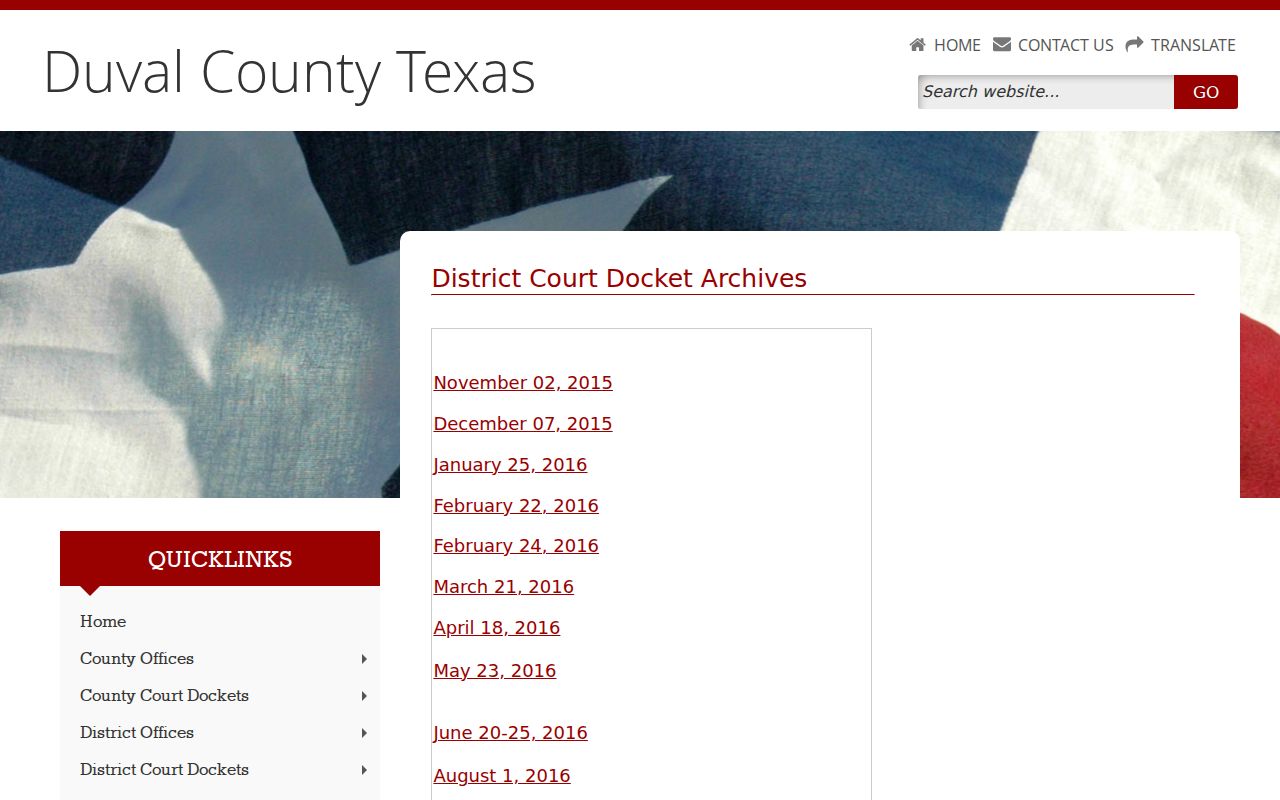
The image is useful as a map to dated files, but the live page remains the source for the newest criminal docket and any changed setting.
Duval Criminal Caseload Context
Fiscal-year 2024 reports from the Texas Office of Court Administration show why the court split cannot be skipped. The Duval district category ended with 279 criminal cases, while the Constitutional County Court criminal category began with 2,003, added 169, disposed of 161, and ended with 2,011. These are annual status categories, not live docket totals and not counts of unique people.
The figures show two distinct criminal streams. They should not be added to claim a current backlog, and they do not describe guilt or outcomes. For a person's own case, the current court docket and clerk record remain the useful sources.
Access Rules for Criminal Dockets
Texas court records do not fit one broad public-information rule. Judicial records held in a judge's judicial capacity are generally governed by Texas Rule of Judicial Administration 12, not handled just like county administrative records under the Texas Public Information Act. Filed case records follow court rules, statutes, and clerk procedures. Ask the custodian which process applies.
Sealed, expunged, juvenile, confidential, or protected material may be withheld or redacted. A missing online result does not prove that no case exists. It may reflect a restricted file, incomplete portal coverage, an old paper record, or a search mismatch. The District Clerk currently posts an SB 1667 expunction notice effective September 1, 2025, with a multi-agency routing list. That notice is procedural information, not a promise of eligibility or deletion.
Key access point: A public docket entry can report an allegation or setting without proving the final outcome. Verify the signed order with the clerk.
Restricted access protects records covered by sealing, expunction, confidentiality, and redaction rules. Do not infer the reason for a missing record.