
Duval County Court Docket Searches
Pull the court name off whatever paper started the matter: a citation, summons, order, or hearing notice. That name tells you which door to knock on. The County Court Dockets page lists dated county criminal calendars, and the District Court Dockets page groups civil, criminal, trial, add-on, assignment, and calendar files. Those PDFs are the quickest local way to confirm a setting in Duval County. Remember, though, they are calendar snapshots. A docket PDF is not a full case history.
Search by cause number whenever you have one. It beats a name every time. Party names work in a pinch, but common surnames and spelling variants invite false matches, so keep the case type, the likely court, and a rough date range close by. Got a city or justice-court ticket? Take it to the court that issued it rather than assuming the county courthouse holds the file.
- Read the paper for the court and cause or citation number.
- Open the matching official county or city calendar.
- Copy the number exactly, including hyphens and suffixes.
- Compare the result with the clerk-linked search channel.
- Confirm the date or requested record with the responsible office.
Duval Docket PDFs Are Snapshots
Duval County releases docket information as dated files. A County Court notice may say a case was moved, postponed, or canceled. The District Court side sometimes posts a later file. It can cover the same calendar period. A saved PDF stays useful as proof of what was posted on a given date. The live setting may change later. When you track a hearing, note the file name and the page that linked it. Then reopen the official page for the newest notice before relying on anything. A calendar change shifts only the timing. It is not a ruling, a dismissal, or a final result. For older calendars, the County Court archive keeps prior postings available.
The official County Court docket source shows the live page where current notices appear.
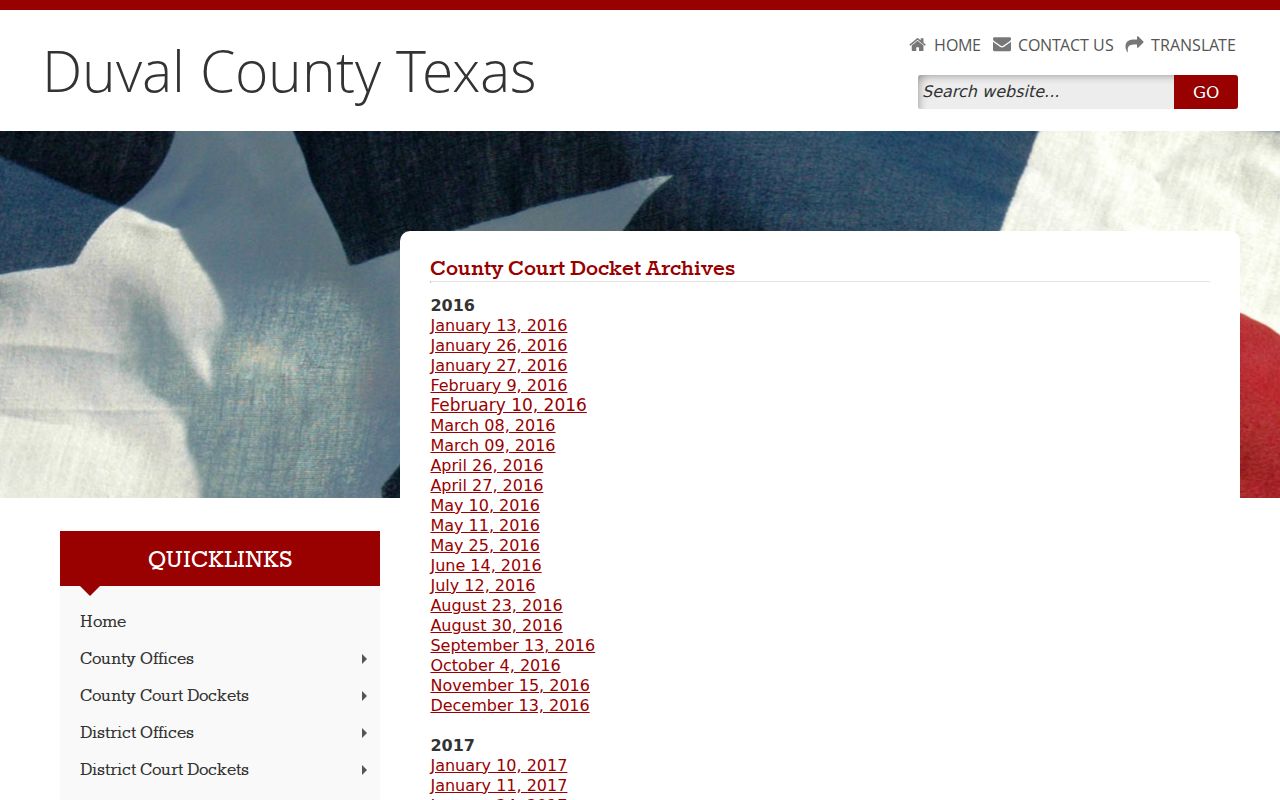
Use that page to confirm you have the right source, then check the live posting itself, since a date visible on a docket page is never a substitute for a current check.
Court Dockets: What They Show
Think of a docket line as a schedule plus a workflow note. Duval district samples list the court, the judge, the docket date, and the start time. Their columns list cause number, style, setting, attorney, notes. The style simply names the parties. A setting shows what the court planned to hear. Notes may mention custody status, counsel, another date, or a filing problem.
Context decides what each field means. A charge on the calendar is just the label used there, not guilt. A motion entry proves a request was filed or set, never that it was granted. Even the word settled in a note is not a signed judgment in the case file.
| Cause number | The court's file key; district criminal examples use a year plus CRD and may include a suffix. |
|---|---|
| Style | The case caption or parties, matched with the court and number. |
| Setting | A pretrial, announcement, arraignment, motion, hearing, trial, or other event. |
| Attorney | Counsel listed for that entry; representation can change. |
| Notes | Scheduling details that do not by themselves prove the outcome. |
Duval Case Numbers Need Context
District criminal calendars sampled in Duval County pair a two-digit year with CRD and a number. Some entries tack on a suffix like -S1-B. That is one district-calendar style. It does not carry over to county, justice, municipal, civil, or older records.
Copy the punctuation exactly as written. If a portal rejects the cause number, ask the clerk how that court formats it. Do not strip characters until some unrelated file pops up. A number is only reliable in context. The court, the case style, and the case type all must line up too.
Quick check: A number that works in one Duval County court may fail in another because each court level keeps its own index.
Duval County Courts and Dockets
Duval County runs several court doors. Felony prosecutions plus broader civil and family matters sit with the 229th District Court. The Constitutional County Court carries its assigned county-level work. That includes misdemeanor and probate cases. Four justice precincts handle fine-only offenses and smaller civil claims. Benavides, Freer, and San Diego each keep a municipal route. That covers city ordinance and fine-only matters.
Appeals from state trial courts go to the Fourth Court of Appeals. Federal cases are a different world entirely. They live in the Southern District of Texas and PACER, not in Duval County court records. Sorting out the level first saves you a long slog through the wrong database.
| Court | Docket covers | First search route |
|---|---|---|
| 229th District Court | Felony, major civil, family, and district matters | District docket page, then District Clerk |
| Constitutional County Court | County criminal, probate, and assigned civil work | County docket page, then County Clerk |
| Justice Courts 1 through 4 | Fine-only criminal and lower civil claims | The precinct named on the paper |
| Municipal courts | City ordinance and fine-only city cases | The named city court |
| Federal court | Federal civil and criminal cases | Southern District or PACER |
Duval Portal Choices Compared
No single statewide search covers every Texas county and court type. For local settings, Duval's own dated pages are the best first stop. The District Clerk links iDocket. Its free name screen takes state, county, last name, and first name. Deeper case history and advanced tools may sit behind a subscription. The vendor's history may lag the coordinator's current hearing calendar.
re:SearchTX adds a statewide layer on top. It offers documented searches for cases, filings, text inside documents, and hearings, plus filters and saved or exported results. What you can see depends on integration, registration, and record permissions. eFileTexas is mainly a filing system. Its full or limited search labels promise nothing about a complete public archive.
| Channel | Best use | Limit |
|---|---|---|
| County docket pages | Dated Duval settings and notices | Not a full file or guaranteed current date |
| iDocket | Name or cause-number research | Coverage varies; some tools are paid |
| re:SearchTX | State case, filing, document, or hearing search | Integration and access control vary |
| eFileTexas | Submitting an electronic filing | Not a universal public archive |
Court Dates in Duval County
Open the court's newest posted PDF first. Compare it against any notice or case information already in hand. A question about a district setting goes to the court coordinator. Need a filed document or a copy? That is District Clerk work. County Court records route to the County Clerk. Justice or municipal dates must be confirmed with the exact precinct or city court.
Setting labels matter more than they look. One district trial docket may split jury selection, arraignment, status, supervision, probation-fee, and pending-motion hearings into separate sections. The date printed at the top does not mean every listed case goes to trial that day. Add-ons and later orders can reshuffle the working list too. The full Duval County court schedule route explains moved and missed settings.
Note: Check the live county page near the setting. An old PDF can stay up after the court announces a change.
Duval Clerk and Coordinator Roles
Rachel S. Vela serves as District Clerk for the 229th District Court. Her office is where copies, filings, and record requests for that court begin. You can find her at 400 E. Gravis St. in San Diego. Mail also works, at PO Drawer 428. The office number is (361) 279-6239. Doors stay open Monday through Friday, 8:00 a.m. to noon and 1:00 to 5:00 p.m. That midday closure is worth planning around before an in-person docket trip.
For hearing dates and district calendar logistics, call Marisela Chapa, the Duval court coordinator. Her number is (361) 279-6233. County-court records fall to County Clerk Araceli “Sally” Lichtenberger. Her first-floor office in the same courthouse answers at (361) 279-6272 or (361) 279-6274. Her counter runs weekdays straight through, 8:00 a.m. to 5:00 p.m.
Duval County Clerk
400 E. Gravis St., first floor
San Diego, TX 78384
(361) 279-6272
Docket Access Under Texas Law
Access to a Duval County court docket depends on what kind of record you want and which office keeps it. Judicial records made or kept in a court's administrative capacity fall under Texas Rule of Judicial Administration 12. Case filings are different. They follow court rules, statutes, common-law principles, and the access process each clerk runs. The Texas Public Information Act covers county administrative records. It is no workaround for restrictions on court files.
Some material stays closed or redacted. Sealed cases, juvenile records, protected family information, identifying data, and expunged or otherwise restricted files can be withheld. The Duval District Clerk posts an SB 1667 expunction notice effective September 1, 2025. Expunction is a legal filing process. It requires notice to agencies rather than being a routine request to scrub a name from a search.
Key access sources:
Texas Rule of Judicial Administration 12 addresses judicial administrative records.
Texas Judicial Branch open-records policy explains the judiciary's request route.
Texas Government Code Chapter 552 contains the Texas Public Information Act.
Duval Court Record Layers
A docket PDF, a case index, a document image, and a certified copy each answer a different question about a Duval County case. The PDF lists planned court work. A case history shows the actions filed and the entries made. A document image shows the filing itself, subject to access rules. A certified copy carries the clerk's formal certification for whatever use demands one.
Ask for the narrowest item that fits your need. Include the court level, cause or citation number, case type, and date range. State the document you want and how it should be delivered. Say whether certification is required. Do not send extra sensitive facts. If you lack the case number, do not worry. Give enough party and date detail for a clerk to tell the file apart from others.
- Setting
- The event scheduled for court consideration.
- Continuance
- An order moving a setting to a later date.
- Disposition
- The recorded result, which should be checked in the file.
- Certified copy
- A copy formally authenticated by the clerk.
How Clerks Keep Docket Records
Clerks receive filings, keep case indexes, and preserve orders. They also hand out public copies when access is allowed. They do not do the judge's job or the coordinator's. Ask the clerk about the filed record. Ask the court coordinator about district hearing logistics. That split matters when a docket PDF and a later case entry seem to clash.
The County Clerk's fee sheet is labeled effective January 1, 2014, though the current page still links it. It lists $1 per page and $5 for county-clerk certification. A records search runs $10 per name. Treat those as historical published amounts. Confirm today's charge and payment method first. Do that before you mail a request or show up at the counter. The Duval County home page shows the local government offices that handle court and clerk records.
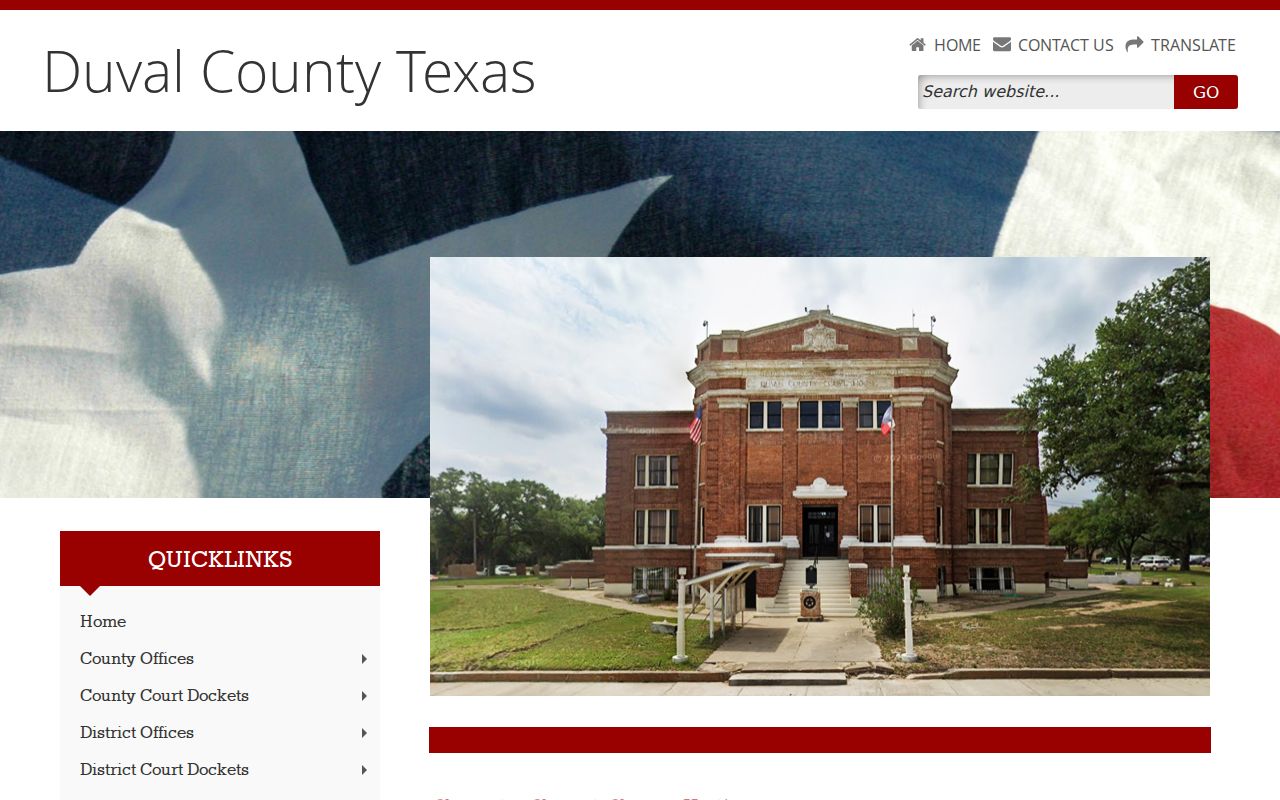
The Duval County home page lists each official office, while the individual clerk pages carry the record-specific details.
Duval Justice Court Routes
Duval County runs four separate justice precincts. Each one stands on its own. Where you live or work does not pick your court. Venue follows the precinct and place printed on the citation or the filing itself, and that pairing controls where any docket search or payment question starts. JP1 and JP2 both sit in San Diego. JP3 holds court at the Benavides Civic Center, and JP4 operates out of Freer.
The county's Justice page breaks out each precinct with its own judge, clerk, phone numbers, mailing route, and payment channel. JP1 and JP4 each run a distinct payment site. JP2 takes payments through a certified-payment service. JP3 posts no full public docket search, so a caller should ask that precinct directly about its current lookup or copy process. If a portal stalls, the precinct clerk is the fastest fix.
Duval Municipal Docket Forks
Fine-only cases in Duval County can land in either a municipal court or a justice court. The two are not interchangeable. Each city runs its own docket its own way. San Diego, for example, sends drivers to an nCourt citation and payment search. You can look up an account there by citation number plus date of birth. Name plus date of birth works too. Driver-license details, plate details, account number, service address, or a name pair also work. Freer takes a similar route through a TrafficPayment search with the same kinds of identifier choices. Keep the limits in mind, though. These forms exist to locate an account so you can pay. They do not hand you the whole docket or a certified case history.
Benavides works differently still. The city publishes a municipal court page and a calendar. It posts no full public searchable register. A specific record request should go straight to that city court. One caution applies everywhere: paying a ticket can carry legal consequences, so read the official plea, driver-safety, and deferred-disposition instructions before you choose an option.
Duval Federal and Appeal Records
Appeals from this area go to the Fourth Court of Appeals. That is an intermediate court. Its docket sits apart from Duval trial-court calendars. Filing a notice of appeal does not convert the county clerk's trial file into the appellate docket, so treat the two records as separate. For appellate case information and rules, use the Fourth Court website.
Federal cases run on a different track. Duval County falls under the Southern District of Texas, Corpus Christi Division. PACER and the national Case Locator are the search routes there. A state cause number will not pull up a federal file. A local docket PDF will not either.
City-by-City Dockets in Duval County
Three incorporated cities sit inside Duval County, and each one runs its own municipal court docket. City-level cases stay at that level. Anything outside a city's jurisdiction lands in the justice, county, or district court instead. Check the city page first for its calendar or citation route, then turn to the county docket search only if the case belongs at a higher court.
Benavides Court Records
Municipal calendar, citation requests, and the city court contact path.
Freer Court Records
Contested dockets, forms, appearance steps, and payment lookup.
San Diego Court Records
City citation search separated from county and district records.
Map and Directions to the Duval County Courthouse
The 229th Judicial District Court's case files are kept with the District Clerk at the Duval County Courthouse, 400 E. Gravis Street in San Diego. Duval Constitutional County Court records are handled separately by the County Clerk on the first floor of that same building. The 229th District Court also serves Jim Hogg and Starr Counties, and its judge's primary listing is in Rio Grande City, but the Duval case file and court coordinator both stay at this San Diego courthouse.
Duval District Clerk
400 E. Gravis St.
San Diego, TX 78384
(361) 279-6239
Monday through Friday, 8:00 a.m. to noon and 1:00 to 5:00 p.m.
Duval County Clerk
400 E. Gravis St., first floor
San Diego, TX 78384
(361) 279-6272
Monday through Friday, 8:00 a.m. to 5:00 p.m.
The District Clerk's lunch closure from noon to 1:00 p.m. affects an in-person trip, so plan around it. Courthouse-wide security, parking, and entrance rules are not fully published in the official sources, so call ahead to confirm current access before visiting.